- Eat at Joe's
- Posts
- Eat at Joe's: For the love of asparagus
Eat at Joe's: For the love of asparagus
My favorite way to cook the spring spears -- especially the fat ones -- involves the broiler and mere minutes.

Joe Yonan
March 22, 2026
Spring spears
I find it almost impossible to resist anthropomorphizing certain foods, and asparagus is one of them. How can you not compare it to a person who’s been asleep under a blanket of snow and tentatively pokes her head out from the covers in the spring? Maybe it’s just me.
Word purists might cringe when they read the following, but asparagus might just be the most unique vegetable I can think of. They would cringe because, I know, I know, “unique” doesn’t have degrees; you are or you aren’t. Well, asparagus most definitely is. Nothing grows like it — a perennial that can produce spears for decades! — and nothing shares its taste (grassy, of course, but also a little sweet and just a touch bitter) and texture (crunchy when raw, crisp when barely cooked, but still substantive when cooked far longer than that).
Table of Contents
When I first started eating asparagus — really, not until I moved to Boston from Texas after college — one of the ironclad rules I (blindly) followed was that you treated it as gingerly as possible when cooking and that you should choose only the thinnest possible spears so you wouldn’t experience anything woody. Sure, sure. Delicious. But the first time I had a really fat spear, the kind you might need a knife and fork to (politely) eat, I was hooked, and those have been my preference ever since.
For one thing, you have a bigger window of doneness, so cooking them just to the texture you want is an easier proposition. And you don’t have to be quite so careful with them, either.
What is the texture I want from cooked asparagus? Usually I look for the spears to give a little when you press on them — or to start to bend when you pick one up. And my favorite way to cook them is under the broiler. I love giving them a touch of char.
The other seemingly ironclad rule for prepping asparagus that I’ve long since ditched is this idea of snapping off their ends wherever they “want” to break. This is because the bottoms do tend to be tougher, but to me, the point that they “want” to break is always so variable it seems to result in wastage of too much of the good stuff. So instead, I just trim off about an inch or so, then quickly run my peeler along the bottom couple inches to remove the toughest skin.
Once they’re broiled, you can pair them with all manner of sauces, use them as a side dish, toss them with pasta or on a salad, and on and on. They’re one of those vegetables that I can’t get enough of, probably because I’ve spend so much of the winter eating root vegetables and leafy greens that the chance to tuck into something, well, meatier, is irresistible.
The recipe I’m sharing today is from “Eat Your Vegetables,” and I pair it with a fun take on Spanish romesco sauce (one of my favorites, as you may remember), and designed to serve just one or two eaters. When your asparagus bounty is, er, bountiful, you know what to do: Be fruitful and multiply.
I break for animals:
Adel

Recipe: Asparagus with Romesco Blanco
|

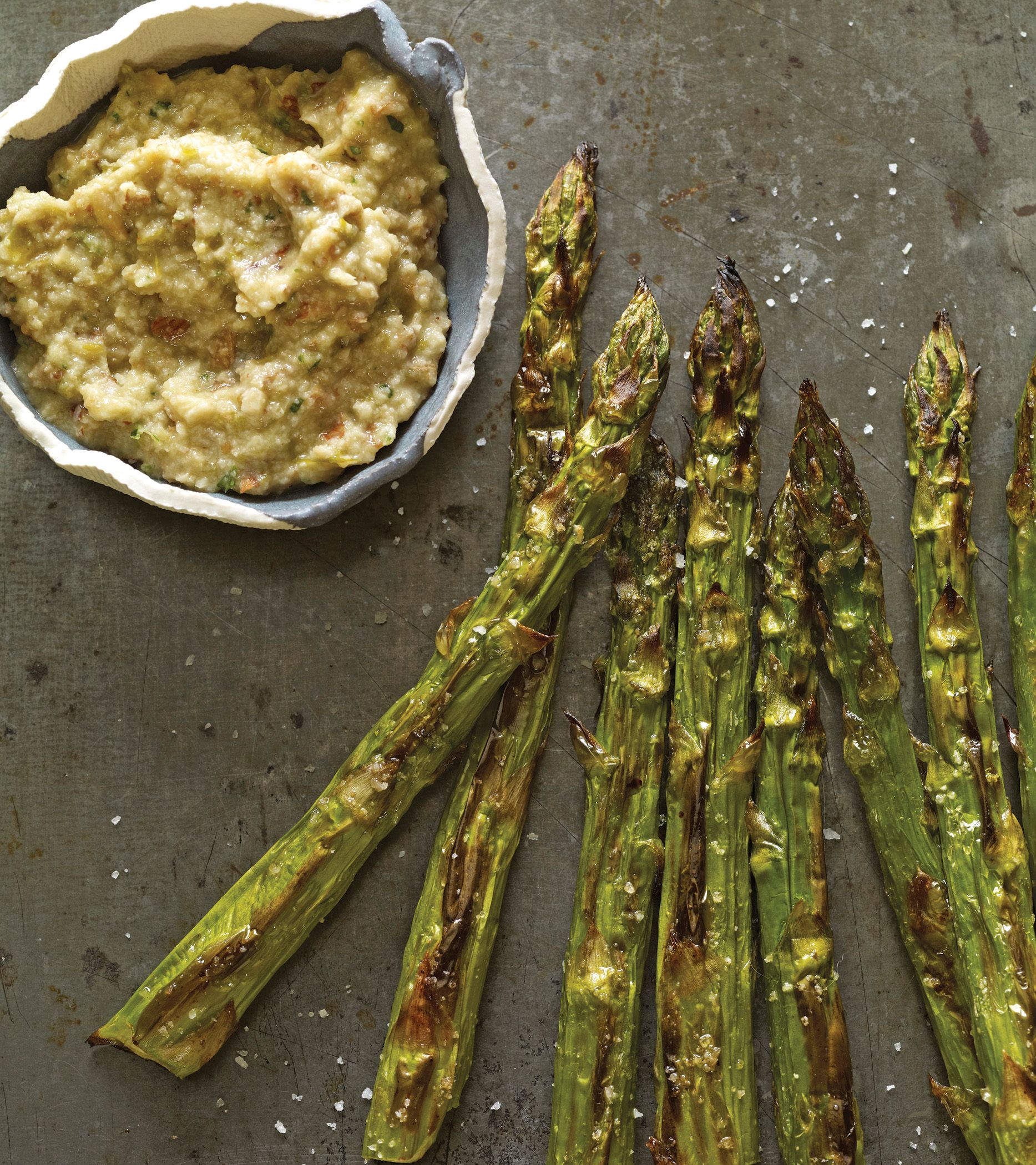
Serves 1 // Time: 30 minutes // Storage: Best served immediately. Romesco blanco can be stored in the refrigerator for up to 3 days.
1 tablespoon sliced or slivered almonds
6 to 8 fat asparagus spears
1 tablespoon plus 1 teaspoon extra-virgin olive oil
Sea salt
2 tablespoons salsa verde, homemade or store-bought
1/2 small slice bread, preferably stale, torn into small pieces
2 large mint leaves
1 teaspoon apple cider vinegar, plus more as needed
2 teaspoons water, plus more as needed
1/2 cup warm cooked brown basmati rice or another grain
Sprinkle the almonds into a small skillet over medium-high heat. Cook, shaking the pan frequently, until the almonds have darkened and become fragrant, just a few minutes. Immediately transfer them to a plate to cool; if you leave them to cool in the pan, they can burn.
Set the oven to broil, and arrange a rack to be 5 or 6 inches from the flame. Cut about an inch of the woody ends off the asparagus and discard them (or reserve them for vegetable stock). If desired, use a vegetable peeler to peel another 2 inches or so of skin off the ends. Toss the asparagus with 1 teaspoon of the olive oil on a rimmed baking sheet. Sprinkle with salt. Broil until the asparagus blackens in spots and the spears just barely bend when you lift them, about 5 to 10 minutes depending on the freshness and size of the asparagus. Remove from the oven.
While the asparagus is broiling, combine the salsa verde with the remaining 1 tablespoon of olive oil and the almonds, bread, mint, vinegar, and water in the bowl of a small food processor or blender, and puree until smooth, adding a little more water if the mixture seems too thick. Taste and add salt and vinegar as desired.
Eat the asparagus over the rice with about 1/4 cup of the sauce spooned on top.
More favorite asparagus recipes
These are gift links to the recipes at the Post. Note that they require you to register but not subscribe. Gift links are free to access for 2 weeks, so if you want to come back to any of these recipes but don’t subscribe or want to subscribe, I suggest you find a way to save them!


That’s it for this week’s newsletter. Do you have friends you think might want to Eat at Joe’s? Invite them today and don’t forget those gifts you can earn through referrals — see above!
If you were forwarded this email, welcome! And know that you can get your very own copy in your very own in-box of your very own phone or laptop on your very own Sundays by clicking below.
Until next week,

Reply