- Eat at Joe's
- Posts
- Eat at Joe's: When beans bake
Eat at Joe's: When beans bake
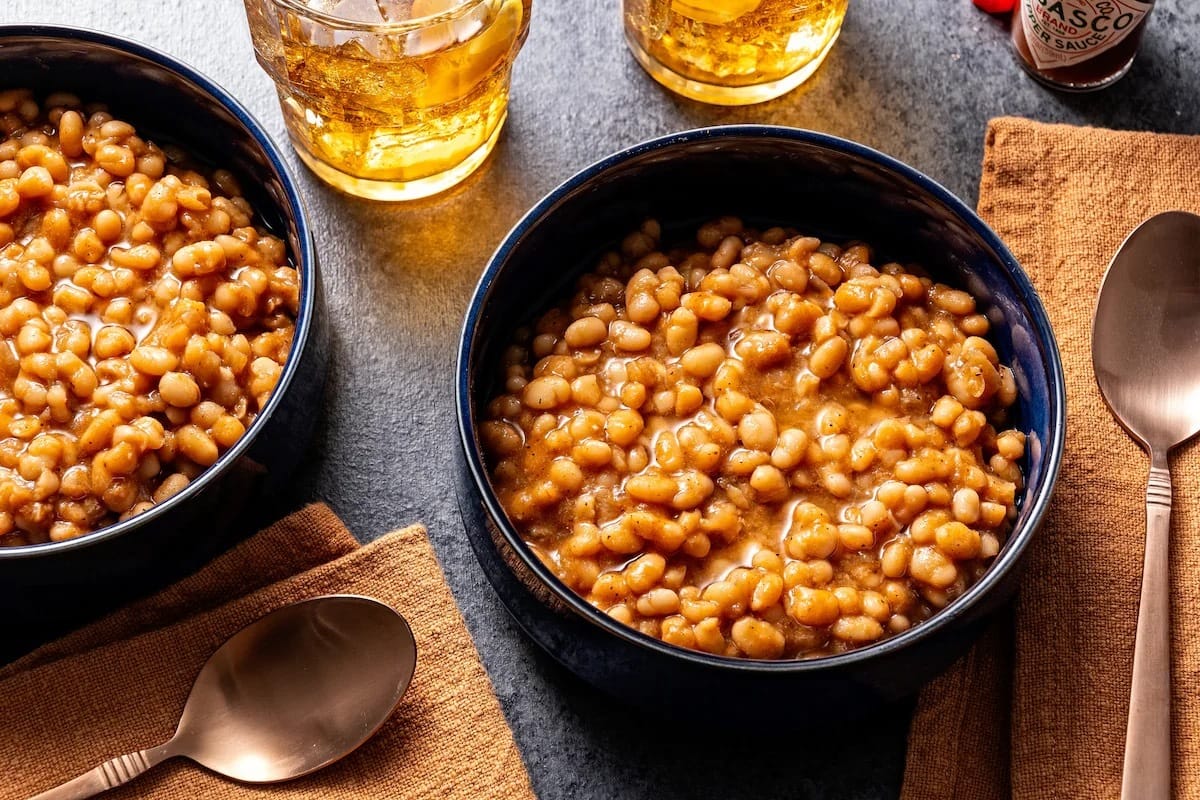
My tribute to the favorite New England-style baked beans my sister and brother-in-law make on their Maine homestead.

Joe Yonan
December 21, 2025

(Photo by Aubrie Pick; food styling by Lillian Kang)
Revolutionary beans
“It’s coming on Christmas, they’re cutting down trees, they’re putting up reindeer and singing songs of joy and peace.”
Here in southern Maine, where I’m spending the week before the holiday, my sister and brother-in-law and I are doing none of the above. Instead, we’re trying to come to terms with the year that’s about to be “was,” and coming up short. How to make sense of nonsense? How to sing of joy and peace when both seem in such short supply?
In today's newsletter
Distraction is a tried-and-true balm, so naturally we talk of fabric and sewing machines and good TV and the disappointing new bakery that opened nearby. And cuddle with Enzo, the pooch my sister calls “the sweetest face I’ve ever seen.” We don’t avoid politics, though. Something infuriating is always seeping out of the White House like the crust on a corroding battery. My brother-in-law, always one to take the long view, slipped me a copy of “Common Sense” by Thomas Paine, which I hadn’t read in decades. You know the upshot: No kings!
The talk of revolution puts me in a baked-beans mood, especially when the weather blusters. (Unlike the setting of Joni’s “River,” it does snow here.)
Boston claims baked beans, and for good reason: The long-cooked, smoky-sweet dish dates back to colonial and pre-revolutionary days, when Puritan settlers who avoided cooking on Sundays would put the beans in to bake the night before. Where they learned the technique has been, like so much food history, the subject of debate.
Did the dish make its way across the Atlantic from the Old World, where, according to the fascinating site Food Timeline it “was prevalent among Staffordshire yeomen, who soaked their dried beans overnight, then baked them along with honey-and-mustard-cured ham and onions or leeks in a narrow-necked earthenware pot especially reserved for the purpose”? (After all, Britain claims baked beans, too, although they got them from the U.S. and a certain company named Heinz.) Or did they learn it from native Americans, who, as Alice Morse Earle wrote in 1898, "baked bean stews in earthen pots placed into pit and covered with hot ashes”?
I didn’t become a baked-beans fanatic until I started spending more time in Maine after my sister moved there what now seems like a lifetime ago. And when I spent 2012 living with her and Peter on their homestead, I got a crash course in one of the state’s favorite ways to make the dish, especially at camps and church events: in a hole in the ground, much like that native tradition. At the incredible Common Ground Country Fair (I highly recommend a visit), the bean-hole beans are a mainstay, served up to attendees who enjoy seeing the process.
In home kitchens, of course, beans have been baked in ovens, from the earliest wood-burning ones to today’s modern induction stoves. And if you had one, an outdoor brick bread oven of the type Peter built outside their home and that we used so often on that year I spent there. Beans are the type of thing you put in as the heat starts its long slide, after the pizzas and bread swell and brown and after the embers get scraped out.

The wood stove at the homestead.
(Photo by Joe Yonan)
Before Rebekah entered the picture, Pete made the beans himself, from a recipe in Woodstove Cookery: At Home on the Range by Jane Cooper, which is cleaved apart at page 144. Cooper credits this recipe to Leila MacGregor of Tunbridge, Vermont, who in turn calls it “an old Vermont family recipe.” Besides preferring to use home-grown beans (Jacob’s cattle variety beans are particularly good for this treatment), Peter’s only deviation is in the sweetener: He uses slightly less molasses than the original recipe calls for and maple syrup (of course) instead of sugar.
The beans started to become vegetarian over the years, especially after Peter read “The China Study” and canceled his order for some piglets for whom he had already made a wooden house. They also, thanks to me and my sister, have become less sweet. For “Cool Beans” I wanted to codify the approach for home cooks without a bread oven, and for that recipe I took the sweetener down a touch more and added a little vinegar for brightening — plus smoked paprika to approximate the work of the traditional salt pork. Oh, and in keeping with the bean-cooking techniques taught to me by Rebekah (and later proven true by America’s Test Kitchen), I started putting in a little kombu to help soften the beans during their first cooking.
A few years ago, my friend Amy Traverso came to visit the homestead for an episode of Yankee Magazine’s public-television show “Weekends With Yankee.” If you want to get an idea of what the homestead is really like, it’s worth a look. Here’s a shortened version of the whole episode, focusing on the bean topic, starting with a visit to Maine bean grower Charley Baer and then showing some stunning images (many of them from overhead) of my sister and BIL’s place, and me finishing up a pot of beans for lunch.
For a shortcut for the long (but worthwhile) process it takes to make the beans, you can use a pressure cooker for the first go and a slow cooker for the second — or an Instant Pot, in two rounds, for everything. Just keep in mind: If you’re using the latter, be sure to spend a little time boiling down the liquid, since that appliance, as much as I love it, tends to create a blander broth because of the lack of evaporation.
With that in mind, if you’re a slow-cooked-bean fanatic, you might look for an earthenware pot like the ones sold by Rancho Gordo. They cradle the beans in a wonderfully gentle heat, resulting in very even cooking, but perhaps just as importantly, their more vertical shape means it takes less water to cover the beans. That turns the broth from cooking any beans or any style of bean dish into something you have to taste.
If you had been a baked-bean skeptic, it’ll convert you. And as we say goodbye to 2025, maybe it can also fuel you — and me, and anybody else who’s as frustrated — for another revolution. What else are we going to do with 2026?
I’ll see you then, by the way. This is the last Eat at Joe’s of 2025; I’m taking next week off and will be back Jan. 4.
I break for animals:
Rue Pinkerton

Recipe: Homesteader’s New England Baked Beans
|

These vegetarian baked beans are twice-baked—first until tender with little other seasoning and then veeeeeerrrrrry slowly with the spices and sweeteners. If you want to shortcut it, use a pressure cooker for the first go and a slow cooker for the second—or an Instant Pot, in two rounds, for the whole shebang.
8 servings // Time: Weekend // Storage: Refrigerate for up to 1 week or freeze for up to 3 months.
Ingredients
1 pound Jacob’s cattle or other plump creamy beans, such as cranberry/borlotti, pinto, or navy
2 (3 by 5-inch) strips kombu (dried seaweed; optional)
1 small yellow or white onion, sliced
1/4 cup molasses
1/3 cup maple syrup
1 teaspoon fine salt, plus more to taste
2 teaspoons dry mustard
1 teaspoon Spanish smoked paprika (pimenton)
1/2 teaspoon ground ginger
1/4 teaspoon freshly ground black pepper
2 tablespoons apple cider vinegar, plus more to taste
Preheat the oven to 350 degrees F.
Combine the beans with enough water to cover by 2 inches in a Dutch oven or other large pot over medium-high heat. Add the kombu. Bring to a boil, turn off the heat, cover, and transfer to the oven. Bake until the beans are very tender, 60 to 90 minutes, checking a time or two to add water if they are no longer covered by it.
Remove the kombu and reduce the temperature to 200 º F. To the pot add the onion, molasses, maple syrup, salt, mustard, paprika, ginger, and pepper and bake for 8 hours, until the beans are falling-apart tender and infused with flavor. Stir in the vinegar, taste, and add more vinegar and salt if needed.
Serve hot, either as a side dish or over roasted potatoes and with a garden-fresh salad for a true Maine homesteader’s meal.
Recipe from “Cool Beans” (Ten Speed Press, 2020), copyright Joe Yonan.
More favorite baked-bean recipes
These are gift links to the recipes at the Post. Note that they require you to register but not subscribe. Gift links are free to access for 2 weeks, so if you want to come back to any of these recipes but don’t subscribe or want to subscribe, I suggest you find a way to save them!

That’s it for this week’s newsletter. Do you have friends you think might want to Eat at Joe’s? Invite them today and don’t forget those gifts you can earn through referrals — see above!
If you were forwarded this email, welcome! And know that you can get your very own copy in your very own in-box of your very own phone or laptop on your very own Sundays by clicking below.
Until next week year,

Reply